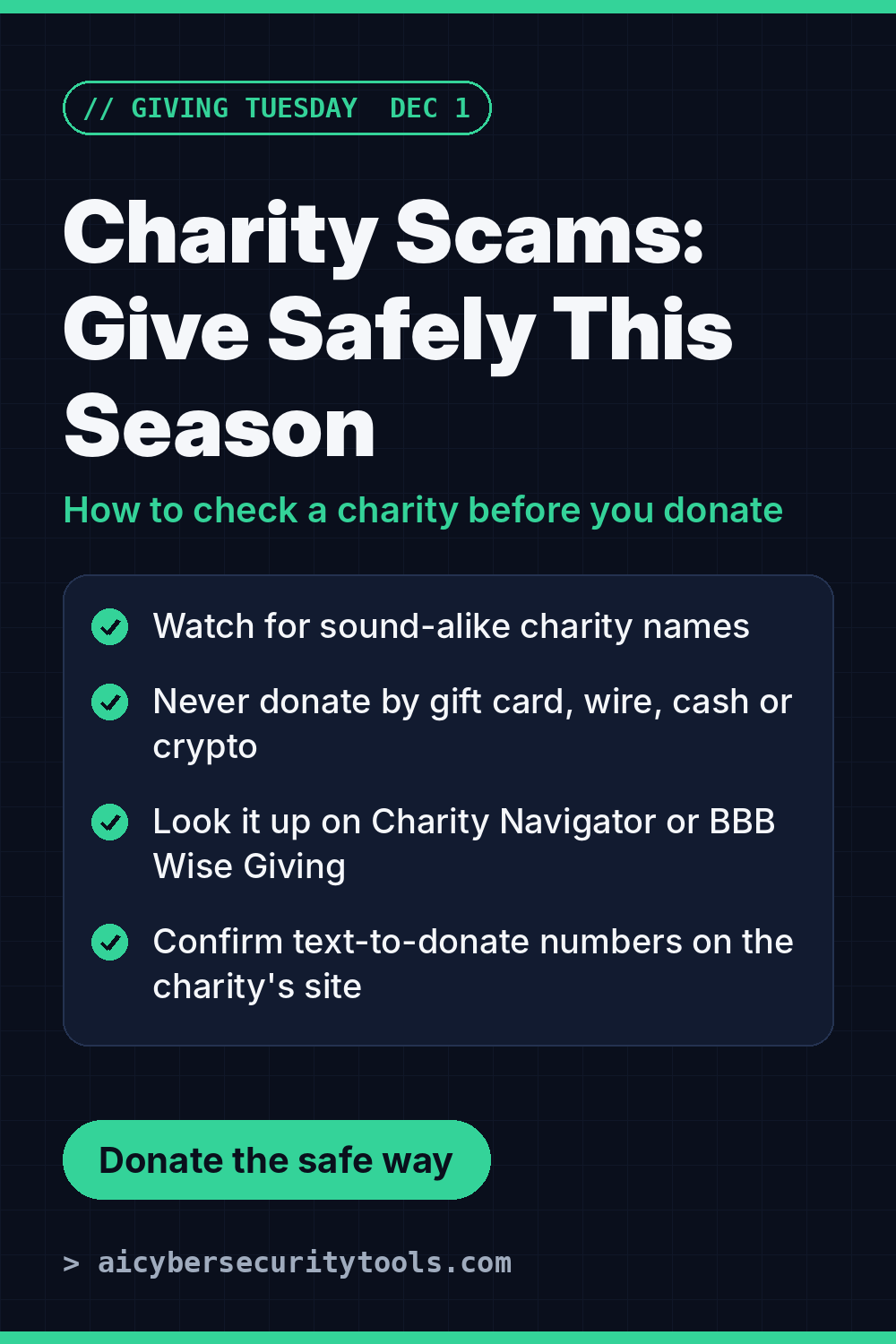
Giving Tuesday falls on Tuesday, December 1, 2026, right after Thanksgiving, Black Friday and Cyber Monday. It’s one of the biggest donation days of the year in the United States, and scammers know it. Fake charities, look-alike fundraising pages and pushy phone calls all spike during the holiday giving season. Here’s how to make sure your money reaches a real cause.
Last updated: November 24, 2026.
The short version
- Give to charities you already know and trust, using contact details you find yourself, like the charity’s own website.
- Never donate by gift card, wire transfer, cash or cryptocurrency. The FTC says those are the payment methods scammers ask for.
- Pay by credit card or check, which leave a record and give you more protection.
- Don’t let anyone rush you. A real charity will still accept your gift tomorrow.
Common charity scams around Giving Tuesday
- Sound-alike names: the scammer uses a name that’s one word off from a well-known charity, hoping you won’t notice. Always check the exact name, website and mailing address.
- Pressure phone calls: a caller says the “matching gift ends tonight” or wants your card number right now. Hang up and give through the charity’s own website instead.
- Fake “thank you” messages: a call or letter thanks you for a donation you never made, then asks you to “renew” it. This trick is meant to make you believe you already support them.
- Social media and crowdfunding posts: emotional posts, sometimes shared by friends, can link to fundraisers run by strangers. Ask the friend whether they actually know the person or group behind it.
- Text-to-donate tricks: a text asks you to donate by replying or clicking a link. Before you give by text, confirm the number on the charity’s official website.
- Fake donation websites: email links and ads can lead to copycat pages built to steal card details. Type the charity’s address yourself. Our guide on how to spot a fake website covers the checks to make.
How to check a charity before you donate
- Search the name plus “scam,” “fraud” or “complaint.” The FTC recommends this simple first step.
- Look it up with charity evaluators such as BBB Wise Giving Alliance, Charity Navigator, CharityWatch and Candid (GuideStar).
- Confirm tax-exempt status with the IRS Tax Exempt Organization Search if you plan to deduct the gift.
- Ask questions on the phone: the charity’s exact name, website and address, and how much of your donation goes to the cause. A real fundraiser can answer; a scammer usually dodges.
Pay the safe way
The FTC says it’s safest to donate by credit card or check after you’ve researched the charity. If anyone insists you pay with gift cards, a wire transfer, cash or cryptocurrency, treat it as a scam. Those payments are hard to trace and almost impossible to get back.
After you give, keep a record of each donation and check your card statement. Make sure you were charged only the amount you agreed to and weren’t signed up for a recurring monthly gift you didn’t want.
If you think you gave to a scam
- Call your card issuer or bank right away and ask to dispute the charge.
- Report it to the FTC at ReportFraud.ftc.gov.
- Report it to your state charity regulator, which you can find at nasconet.org. Share the organization’s name, the phone number or link used, and what they told you.
- If you shared card or bank details on a fake page, follow our 7 steps to take after a data breach.
For a full list of US reporting options, see where to report cybercrime and online scams in the United States.
Frequently asked questions
When is Giving Tuesday 2026?
Giving Tuesday 2026 is on Tuesday, December 1, the Tuesday after US Thanksgiving (November 26).
Is it safe to donate through a link on social media?
Only if you can confirm who gets the money. The safest route is to go to the charity’s own website by typing the address yourself, rather than clicking a link in a post or message.
Can a real charity ask for gift cards or crypto?
Be very suspicious. The FTC warns that a fundraiser who says cryptocurrency is the only way to give, with no option for checks or credit cards, is likely a scam. Gift card and wire requests are classic scam signs.
Sources: Federal Trade Commission consumer advice at ftc.gov/charity.